Whilst driving to and from work, two news stories about space have caught my attention recently. The first has been NASA’s continuing preparations to “go back to the moon,” as they called it, and the second has been the story of the space station evacuation due to the serious illness of one of the astronauts. Space stories always catch my attention. I don’t know why. I’ve never had astronautical aspirations. I’m not in the least bit scientific. Perhaps it’s my scientific ineptitude that adds to my sense of wonder, a kind of, how on/off earth do they do that, build a space station, fire it into space, have it orbit the globe while the astronauts on board transmit pictures and data that tells us about our planet and the universe where it hangs like an emperor whirly in the midst of a billion marbles tossed into the void?
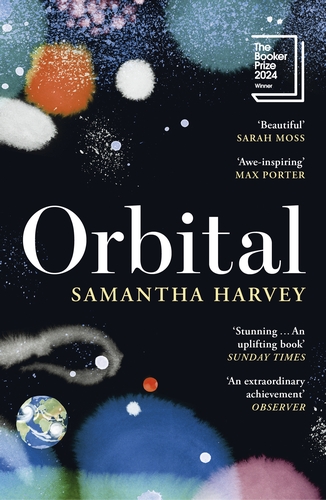
The space station story had particular currency for me as I had just finished reading Samantha Harvey’s stunning novella, Orbital. To say, “I’ve never read anything like it” is clichéd, I know, but I have never read anything like it. From its fascinating map at the beginning, with the space station orbits interweaving like a perfect web around an elongated earth, to its blend of intense humanity and breathtaking sense of fragility, it almost feels like a book that every human being on the planet should read, as a reminder of our fortune in the very earth we inhabit.
But as well as the beauty in the novella, and there is plenty (sixteen sunrises and sunsets in a day; the Northern lights seen from space), there is an unavoidable pathos, not forced upon the reader through sentimentality, but present as a bi-product of having our planet so poignantly rendered from the vantage point of the astronauts that we can only imagine, based on what we have seen in pictures or from the windows of long haul flights. In “Orbit 7”, as the craft tracks 200 miles above a “brilliant Indian Ocean of blues untold”, we read that the astronauts,
were warned about what would happen with repeated exposure to this seamless earth. . . its fullness, its absence of borders except those between land and sea. . . no countries, just a rolling indivisible globe which knows no possibility of separation, let alone war;
warned also that they would feel themselves,
pulled in two directions at once. Exhilaration, anxiety, rapture, depression, tenderness, anger, hope, despair. Because of course you know that war abounds and borders are something that people will kill and die for.
At the risk of sounding naïve and idealistic, it’s as if everything we think we know as people, the histories we’re taught, the news we are fed on television, internet and social media, the logics of geopolitical disputes we are force-fed, the rants about immigration and borders, and the bully-boy justifications for violence and land-grab are all immediately eclipsed by the simple truth of having our beautiful planet shown to us from space:
the small and distant rucking of land that tells of a mountain range . . . a vein that suggests a river . . . no wall or barrier – no tribes, no war or corruption or particular cause for fear.
It’s rare to have your worldview (quite literally) shaken and flipped in this way by a book. Most of what we read echoes and confirms our entrenched beliefs. But after Samantha Harvey’s Orbital, it feels like an absolute necessity to read something so profound, to have our worldview reminded and realigned by the simple fact of being transported into orbit with these astronauts and shown our earth from just 200 miles away in near space.
 Point Quote Comment
Leave a comment