Words by J. Patrick Armstrong
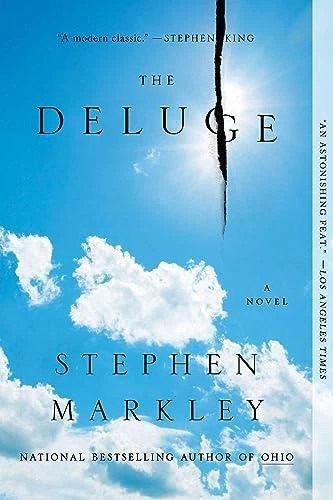
It’s quite rare for a book to actually frighten me, to show me a familiar world and rip it apart with such skill, dexterity and reach that I am left with the awful conclusion that the apocalyptic horrors foretold in its pages will, almost certainly, come to pass. But that’s how I felt, at times, reading Stephen Markley’s Deluge (2023), essentially a novel that takes on the next decade or so of the climate crisis, but also a damning indictment of contemporary America and the world.
As he showed in his brilliant debut, Ohio (2017), Markley is a master at weaving disparate stories within multiple overarching themes. But where Ohio (as the title would suggest) limits its circumference to interlocking tales of characters from said state, Deluge takes America in the 2030s as its setting, attempting to map, through multiple narratives and faux legislation, the country’s lead role in the death throes of civilization itself. Through visceral accounts of savage storms, biblical floods, hellish fires, mass shootings, violent government crackdowns, assassinations, riots, lynchings, social media hate campaigns, and financial meltdowns, Markley achieves a bleakness in some ways more affecting than The Road (Cormac McCarthy’s benchmark of apocalyptic fiction), as the reader recognises Deluge’s phenomena as part of our doom-obsessed 24-hour news cycle. “Now everyone was getting a glimpse of what you long knew,” the narrator informs hapless Keeper in second person as he (and the reader) is blindly and tragically enmeshed in a domestic terror plot (shades of Don DeLillo’s Libra), “the fragility of all those things that seem so permanent and steadfast. How very simple it is for everything and everyone to go away.”
And yet, through the character and symbolism of Kate Morris, a free-spirit climate activist who faces down an armoured car as government forces slaughter hundreds of their own citizens in a brilliantly and brutally conceived American echo of the horrors of Tiananmen Square, Markley gives his readers a chink of hope in the sinews of humanity itself, both individual and community. Indeed, dotted throughout the novel’s end-of-days scenarios are small acts of heroism and kindness that function as tiny human buffers against the planetary forces and greedy politico-economic ignorances that threaten the global population. So that by the end of the novel, exhausted, hopeless and futile as the reader might feel, we might just, as Kate Morris’s ex-boyfriend eventually does,
“believe we would free ourselves of these mournful histories, that all our tears and sorrow would be given back to us, and though we walked these ruins now, we would begin again, and carry across impossible time the glory of this ancient and magnificent world.”
While it would be all too easy here to be cynical and accuse Markley of squirming out of the apocalypse of his own complex construction by offering this light at the end of a very long, dark tunnel, his faith in human beings, their relationships, their importance to each other, and the power of their combined intelligence and scientific resourcefulness offers an ending of hope as a beacon of resistance to the ubiquity of doom in our contemporary, convulsive world.
 Point Quote Comment
Leave a comment